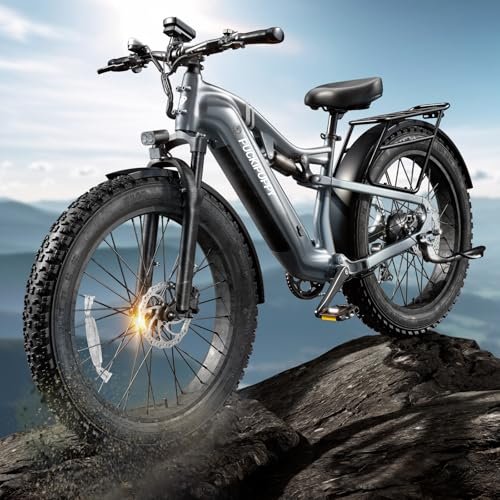
8 Best Electric Bikes Under $1000 Compared
Research-Based — compiled from manufacturer specs, verified owner feedback and retailer data
Last updated: October 2026
You can buy a usable electric bike for under $1,000. You cannot buy one that does everything a $2,500 bike does — and knowing the difference before you order is what separates a bike you ride daily from one that gathers dust.
Quick Summary
- Top pick 1 — TST 1500W Peak Fat Tire: the best all-round budget buy here, with 750W continuous power, a 720Wh battery and a 450 lb payload.
- Top pick 2 — Cybervelo 26″: the sensible paved-road commuter, with the longest usable claimed range of the conventional bikes here (80+ miles, claimed).
- Top pick 3 — Gotrax R1 Folding: the storage problem solved — 45 lbs and folds to about 37 x 18 x 28 inches.
- Lowest price — ESKUTE V100: the cheapest bike in this line-up at $319.99 — a compact first e-bike for teens and shorter riders (16-inch wheels).
- Longest-range pick (claimed): ANDSKY Apex50 — up to 110 miles claimed from the largest battery here (about 1,300Wh); treat that figure with real caution.
- Who this guide is for: budget-first buyers in the US choosing a first e-bike for commuting, errands, light trails or teen riding — and willing to trade premium parts for a price under $1,000.
Here is what the budget end realistically gives you. Frames are aluminium or carbon steel rather than lightweight alloys. Batteries are smaller, so genuine range falls well short of headline claims. Brakes are mostly mechanical disc rather than hydraulic. Motors are advertised by a large peak figure, while the lower continuous rating is what you feel on a long hill. For price context, under $1,000 is the entry tier of the US market — stepping above it is typically what buys hydraulic brakes as standard and longer support, which is why every bike below involves a visible compromise.
None of that makes these bikes a bad buy — you just have to match the bike to the job. A short, flat commute is a different job from carrying a heavier rider up gravel tracks.
Three rules help when reading any budget listing. Treat range claims as best cases — light rider, low assist, flat ground — then discount them by a third to a half. Compare batteries in watt-hours, not just amp-hours. And check both payload limit and the bike’s own weight.
The eight bikes below cover the main budget jobs: fat-tire riding, commuting, folding storage, trails, moto styling, dual-motor traction, step-through access for heavier riders, and a compact option for teens. See also affordable e-bike reviews and buying guide.
Quick Picks
- Best for fat-tire off-road riding: TST 1500W Peak Fat Tire Electric Bike
- Best for city commuting range: Cybervelo 26″ Electric Bike
- Best for folding commuter use: Gotrax R1 Folding Electric Bike
- Best for foldable trail riding: Jasion X-Hunter Foldable Fat Tire Ebike
- Best for motorcycle-style design: Qlife Spark Electric Dirt Bike
- Best for high-power AWD performance: ANDSKY Apex50 Dual Motor Ebike
- Best for heavier riders needing range and step-thru design: Aipas M1 Pro
- Best for teens and younger riders: ESKUTE V100 Electric Dirt Bike
How We Researched This Guide
We are the EBikePeak team — riders and researchers who cover budget e-bikes full-time — and we built this guide from documents, not impressions. For each model we cross-checked the manufacturer’s published specifications against retailer listing data, then read verified owner feedback for the problems spec sheets never show: real range shortfalls, assembly complaints, parts failures and support experiences. Where sources disagreed — on speed or range, for example — we say so in the review rather than repeating the bigger number.
Our limitations, honestly stated: this is a research-based guide, so we do not claim to have ridden or bench-tested these eight bikes, and no figure here should be read as our own measurement. Range and top-speed figures are manufacturer claims unless we label them as owner-reported, and we discount them openly throughout. Prices and specifications were checked at the time of writing in October 2026, but budget e-bike prices, listings and specifications change frequently — confirm both on the product page before you buy.
1. TST 1500W Peak Fat Tire Electric Bike
If your riding mixes broken streets with gravel, dirt and occasional snow or sand, start here. Twenty-inch wheels with 4-inch fat tyres and dual suspension smooth out surfaces that would rattle a rigid commuter. The standout figure is the 450 lb payload — unusually generous under $1,000.
Power is rated at 750W continuous with a 1500W peak, from a removable 48V 15Ah battery. Claimed range is up to 40 miles on throttle and 60 miles with pedal assist; plan on roughly 30 to 40 miles on mid-level assist, because wide tyres add rolling resistance. That battery equals 720Wh (48V x 15Ah), and a full charge is quoted at six to seven hours.
| Spec | Detail |
|---|---|
| Motor | 750W continuous / 1500W peak |
| Battery | 48V 15Ah, removable |
| Range | Up to 40 miles throttle / 60 miles pedal assist (claimed) |
| Top speed | Not specified |
| Weight | Not specified (payload 450 lbs) |
| Drivetrain / Brakes | 7-speed / Mechanical disc |
What we like:
- 450 lb payload, rare at this price
- Fat tyres and dual suspension for mixed surfaces
- Removable battery, SGS / UL2849 certification listed
- Largely pre-assembled, per owner feedback
What to consider:
- Mechanical brakes need more hand effort than hydraulic
- 180-day warranty, shorter than one-year rivals
- Fat tyres cut efficiency on tarmac
Who it’s for: Heavier riders whose routes leave smooth pavement.
Who should skip it: Skip it if you want hydraulic brakes or a longer warranty, as this bike uses mechanical brakes and a 180-day warranty.
2. Cybervelo 26″ Electric Bike
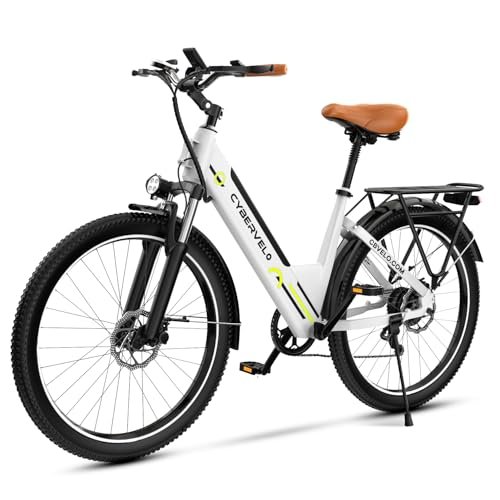
The Cybervelo takes the opposite approach: a familiar 26-inch shape, narrow 1.95-inch tyres and front suspension only. Handling feels predictable, and the narrow tyres roll efficiently on tarmac — part of how it supports its long claimed range.
That claim is up to 80-plus miles in pedal-assist mode, from a 48V battery listed at 10,400 mAh, with a motor rated at 750W continuous and 1000W peak. Treat it as a ceiling for gentle assist on flat routes. Even discounted, it should cover most commutes with charge to spare. The carbon steel frame is heavier than aluminium but tough, braking is mechanical disc with EABS support, and front-only suspension suits paved roads.
| Spec | Detail |
|---|---|
| Motor | 750W continuous / 1000W peak |
| Battery | 48V, 10,400 mAh |
| Range | Up to 80+ miles pedal assist (claimed) |
| Top speed | Not specified |
| Weight | Not specified (payload 350 lbs) |
| Drivetrain / Brakes | 7-speed / Mechanical disc with EABS |
What we like:
- Longest claimed range in this roundup
- Familiar, conventional bicycle feel
- EABS support alongside disc brakes
- One-year warranty
What to consider:
- Steel frame is comparatively heavy
- Narrow tyres grip poorly on loose ground
- No rear suspension
- Limited seat adjustment for shorter riders, per owner feedback
Who it’s for: Pavement commuters who want maximum range and a conventional bicycle feel.
Who should skip it: Skip it if you ride loose ground or need rear suspension, as its narrow tyres grip poorly off tarmac and it has front suspension only.
3. Gotrax R1 Folding Electric Bike
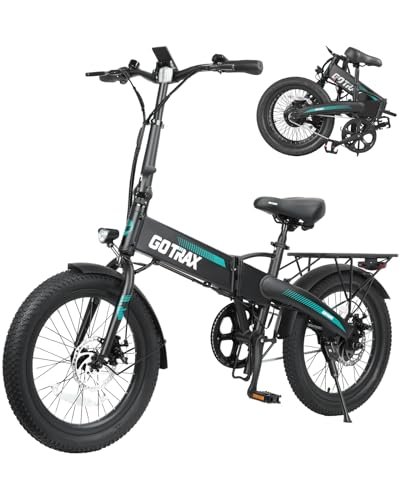
Storage and transport decide many budget purchases, and that is the problem the R1 solves. At 45 lbs it is the lightest bike here, folding to roughly 37 x 18 x 28 inches — small enough, owners confirm, for most car boots and flat corners. If you carry the bike inside nightly, that may matter more than motor size.
The trade-off is performance. The motor is rated at 350W continuous and 500W peak, and the 48V 7.8Ah battery is the smallest here: up to 15.5 miles electric-only and 25 miles with pedal assist. That suits short hops, not long or hilly commutes. Charging takes about 5.5 hours, and the 264 lb payload is the lowest here. UL2849 certification is listed, the frame is aluminium, and a 180-day defect warranty applies.
| Spec | Detail |
|---|---|
| Motor | 350W continuous / 500W peak |
| Battery | 48V 7.8Ah |
| Range | Up to 15.5 miles electric / 25 miles pedal assist (claimed) |
| Top speed | Not specified |
| Weight | 45 lbs (payload 264 lbs) |
| Drivetrain / Brakes | 5-speed / Dual disc |
What we like:
- Lightest bike here, at 45 lbs
- Compact fold for cars, flats and transit
- UL2849 certification listed
- Simple, approachable for first-time owners
What to consider:
- Shortest range in this group
- Lowest payload, at 264 lbs
- Small motor strains on hills
- No rear suspension
Who it’s for: Students and multi-modal commuters with short daily distances and little storage.
Who should skip it: Skip it if you need long range, a higher payload or hill climbing, as it has the shortest range, the lowest payload and a small motor that strains on hills.
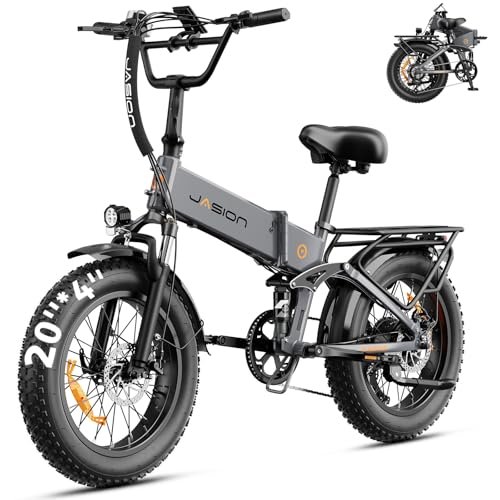
4. Jasion X-Hunter Foldable Fat Tire Ebike
Folders usually ask you to give up trail ability. The X-Hunter tries not to: a folding aluminium frame, 20 x 4.0-inch fat tyres and dual suspension, including an 80mm front air fork — a genuine upgrade over the basic coil forks on most budget bikes. A rear shock completes the off-road intent.
The brushless motor is rated at 1400W peak, fed by a removable 48V 13Ah battery (624Wh) with a claimed 55 to 70 miles of pedal-assist range. Owner feedback is mixed: battery consistency has been questioned, and at least one report puts real sport-mode speed nearer 22 mph than the advertised 30 mph. It folds to about 33 x 16 x 30 inches, but at 71 lbs this is a fold for storage, not carrying. UL2849 certification and a one-year warranty are listed.
| Spec | Detail |
|---|---|
| Motor | 1400W peak, brushless |
| Battery | 48V 13Ah, removable (624Wh) |
| Range | 55–70 miles pedal assist (claimed) |
| Top speed | 30 mph claimed; owner reports suggest less |
| Weight | 71 lbs |
| Drivetrain / Brakes | 7-speed / Mechanical disc |
What we like:
- Folding frame plus fat tyres and dual suspension
- Front air fork, unusual at this price
- Removable battery, UL2849 listed
- One-year warranty
What to consider:
- Heavy at 71 lbs despite folding
- Mechanical rather than hydraulic brakes
- Variable battery feedback from owners
Who it’s for: Riders short on storage who still ride trails.
Who should skip it: Skip it if you need a light bike to carry or hydraulic brakes, as it weighs 71 lbs despite folding and uses mechanical brakes.
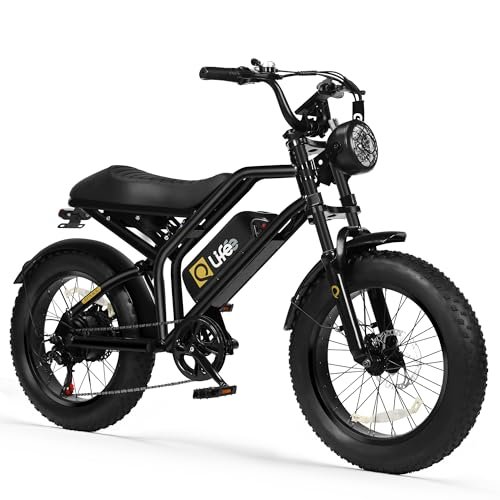
5. Qlife Spark Electric Dirt Bike
Some buyers want transport; others want a bike that looks like a small motorcycle. The Spark is for the second group: moto styling, 20 x 4.0-inch fat tyres, dual suspension and four riding modes.
The motor is rated at 1800W peak, and the 48V 15.6Ah battery is one of the larger units here, with UL2849 certification listed. No single firm range figure is given in the source data — it varies by mode and rider weight — so plan distances conservatively. A centre-mounted colour LCD is a nicer touch than the basic displays common at this price, and braking is by dual disc brakes described as motorcycle-grade.
The compromises are practical. The steel frame adds weight, owner feedback includes an early battery failure, and the assembly instructions have been criticised. Allow extra build time and keep the one-year warranty paperwork.
| Spec | Detail |
|---|---|
| Motor | 1800W peak, brushless |
| Battery | 48V 15.6Ah, UL2849 certified |
| Range | Not specified — varies by mode and weight |
| Top speed | Not specified |
| Weight | Not specified |
| Drivetrain / Brakes | 7-speed / Dual disc, described as motorcycle-grade |
What we like:
- Distinctive motorcycle styling, dual suspension
- Large, certified battery for the price
- Four riding modes, colour LCD display
- One-year warranty
What to consider:
- Heavier steel frame
- No firm published range figure
- Assembly guidance criticised; one early battery failure reported
Who it’s for: Style-led off-road riders comfortable with a heavier bike and a home build.
Who should skip it: Skip it if you need a firm published range figure or a light bike, as it has a heavier steel frame and no firm range figure.
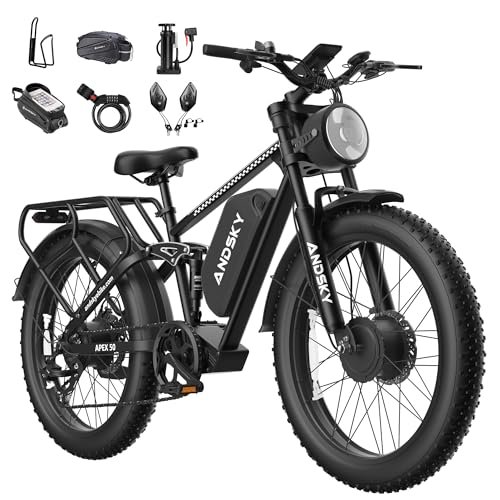
6. ANDSKY Apex50 Dual Motor Ebike
The Apex50 is the outlier: two motors, all-wheel drive, the biggest battery here and the only hydraulic brakes. It is built for traction — sand, snow and steep loose climbs where a single motor struggles to grip — not for simple, light commuting.
Its combined peak output is listed at an extraordinary 9000W, the removable battery at 52V/48V 25Ah (about 1300Wh), claimed range at up to 110 miles and claimed top speed at 40 to 47 mph. Those numbers need the strongest caution in this guide: the model has few owner ratings so far, real results will vary heavily, and speeds that high exceed US e-bike class limits for public roads.
The hardware is still notable under $1,000: dual-piston hydraulic brakes stop more consistently than the mechanical systems elsewhere here, the frame is aluminium, suspension is front and rear, tyres are 26 x 4-inch fat tyres, and UL2849 certification, a one-year warranty and an accessory bundle are listed — though some owners say the accessories fit poorly.
| Spec | Detail |
|---|---|
| Motor | Dual motor, 9000W peak combined (claimed) |
| Battery | 52V/48V 25Ah, removable (1300Wh) |
| Range | Up to 110 miles (claimed) |
| Top speed | 40–47 mph (claimed) |
| Weight | Not specified |
| Drivetrain / Brakes | 7-speed / Dual-piston hydraulic disc |
What we like:
- Dual-motor AWD for loose, steep terrain
- Only hydraulic brakes in this roundup
- Largest battery listed here
- UL2849 and one-year warranty listed
What to consider:
- Exceptional claims, lightly evidenced so far
- Small pool of owner ratings
- Claimed speeds exceed public-road e-bike classes
- Overkill for most commuters
Who it’s for: Experienced off-road riders who need dual-motor traction and accept a less proven model.
Who should skip it: Skip it if you want a proven, road-legal commuter, as its exceptional claims are lightly evidenced and its claimed speeds exceed public-road e-bike classes.
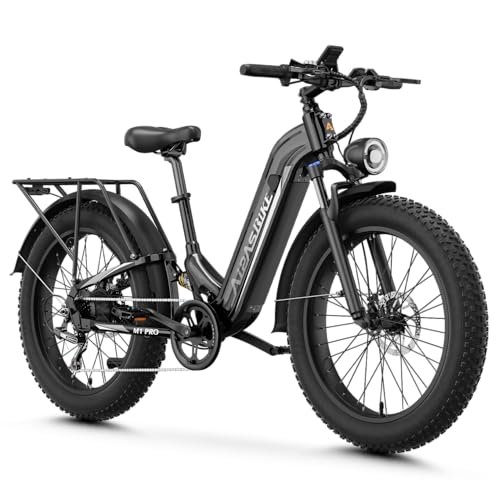
7. Aipas M1 Pro
The M1 Pro combines three things budget buyers rarely get together: an easy-mount step-through frame, a 450 lb payload, and a large battery. Add 110Nm of torque — how a bike pulls away and climbs — and it is the most accessible heavy-duty option here.
The motor is rated at 750W with an 1800W peak, and the 48V 17.5Ah battery (840Wh) is rated for up to 85 miles. That applies only at the lowest assist on flat ground; 35 to 50 miles is a realistic mixed-use estimate. Tyres are 26 x 4-inch fat tyres, suspension is dual with a lockable front fork, and braking is by 180mm mechanical discs. A USB port and included rear basket help with errands.
Two cautions: owners consistently describe the bike as heavy, so stairs and vehicle loading are real obstacles, and safety certification is not prominently disclosed in the listing — verify it with the seller if your building or insurer requires it.
| Spec | Detail |
|---|---|
| Motor | 750W rated / 1800W peak, 110Nm torque |
| Battery | 48V 17.5Ah (840Wh) |
| Range | Up to 85 miles claimed; ~35–50 miles typical mixed use |
| Top speed | Not specified |
| Weight | Not specified — described as heavy by owners (payload 450 lbs) |
| Drivetrain / Brakes | 7-speed / 180mm mechanical disc |
What we like:
- Step-through frame, 450 lb payload
- 110Nm torque for hills and loads
- Large 840Wh battery, rear basket included
- USB charging port
What to consider:
- Heavy to lift or load
- Headline range needs gentlest conditions
- Certification not clearly disclosed
Who it’s for: Heavier and returning riders needing an easy mount and strong hill torque, with ground-level storage.
Who should skip it: Skip it if you must lift the bike often or need clearly disclosed certification, as it is heavy to lift and its certification is not clearly disclosed.
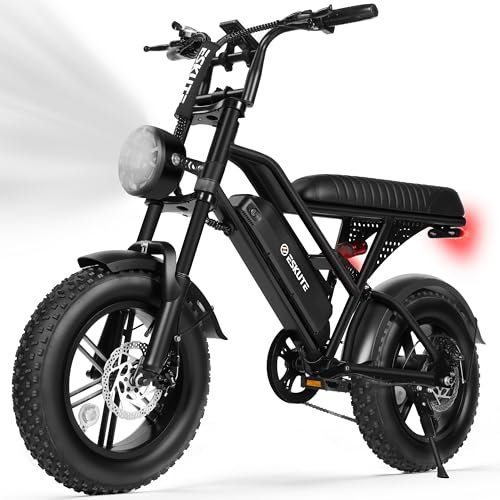
8. ESKUTE V100 Electric Dirt Bike
The V100 is the compact member of the group. Sixteen-inch wheels with 4.0-inch fat tyres lower the standover height, making it approachable for teens and shorter adults overfaced by a full-size frame; minimum rider height is listed at 5.1 feet. The bold moped-style design is part of the appeal for younger riders.
On paper it is strong for a small bike: a 1500W peak motor and a 48V 13Ah battery (624Wh) rated for up to 60 miles with pedal assist. Discount that hard — buyer feedback points to real distances nearer 20 miles at mid-level assist. Dual suspension and wide tyres keep light trails comfortable, with dual disc brakes and a 7-speed drivetrain.
Owners also flag seat comfort on longer rides, and one reported a rear wheel defect on arrival, so inspect the bike at delivery. This is a supervised first e-bike, not a full-size adult commuter.
| Spec | Detail |
|---|---|
| Motor | 1500W peak |
| Battery | 48V 13Ah |
| Range | Up to 60 miles claimed; ~20 miles at mid assist per owner reports |
| Top speed | Not specified |
| Weight | Not specified (minimum rider height 5.1 ft) |
| Drivetrain / Brakes | 7-speed / Dual disc |
What we like:
- Low standover suits teens and shorter riders
- Dual suspension and fat tyres
- Strong peak output for a compact bike
- Bold moped styling
What to consider:
- Real range far below the claim, per buyers
- Seat comfort criticised for longer rides
- Too small as an adult’s main commuter
Who it’s for: Supervised teens, shorter adults and families wanting a manageable first e-bike.
Who should skip it: Skip it if you need a full-size adult commuter or long-ride seat comfort, as it is too small as an adult’s main commuter and seat comfort is criticised on longer rides.
Buying Guide: How to Choose Under $1,000
Spending less means knowing which compromises affect you. Work through the six areas below, and cross-check against affordable e-bike reviews.
Motor power
Manufacturers lead with peak wattage because it is the biggest number, but continuous wattage is what a motor can sustain — and what you feel on hills. A 750W continuous bike will out-climb a 350W continuous one whatever their peak figures say. For flat, short trips, 350–500W continuous is workable; for hills, cargo or heavier riders, prioritise 750W and check torque where published. For legal context, US federal consumer law defines a low-speed electric bicycle as having a motor under 750W, and the class system used by most states caps assistance at 20 mph for Class 1 (pedal assist only) and Class 2 (throttle allowed), and 28 mph for Class 3 (pedal assist only). A motor advertised far above 750W peak, or a bike that exceeds those speeds, may fall outside those classes where you live.
Battery and range
Multiply volts by amp-hours to get watt-hours: 48V x 15Ah is 720Wh, while 48V x 7.8Ah is about 374Wh — roughly half the energy and, broadly, half the range. Removable batteries matter if you charge indoors. Then apply the discount: weight, hills, wind, cold, high assist and throttle use commonly cut claimed range by 30 to 50 percent. Buy enough battery that a normal round trip uses about half the claimed range. A useful rule of thumb is consumption of roughly 20Wh per mile at moderate assist: on that basis a 720Wh pack points to around 35 miles of throttle-heavy riding, while gentle pedalling can stretch the same pack much further — which is exactly why claimed and real figures diverge. Charging is slow at this price, too: of the models here that publish a charge time, figures run from about 5.5 hours (Gotrax R1) to six to seven hours (TST), so overnight charging is the normal routine.
Brakes
At 20 mph and above, braking is not a detail. Hydraulic discs give the strongest, most consistent stopping with least hand effort — and are rare at this price, appearing once here. Mechanical discs are the norm: effective, and cheaper to adjust yourself, but they need more lever force, especially on descents or in the wet. Check pads regularly.
Suspension
Front suspension is enough for smooth tarmac, and saves weight and cost. Dual suspension earns its place on gravel and trails, at the cost of weight and maintenance. Fat tyres add cushioning of their own.
Weight
Most budget e-bikes weigh 45 to 75 lbs, and that decides daily practicality. A 45 lb folder can be carried upstairs; a 70 lb-plus fat-tire bike generally cannot, and many car racks are not rated for it. Check the bike’s weight, its payload limit, and your rack limits together. A step-through frame makes a heavy bike easier to mount, not easier to carry.
Safety and certifications
Look for UL2849 certification, the standard covering the complete e-bike electrical system — drive unit, battery and charger together. It is a step beyond UL2271, which certifies the battery pack alone for light electric vehicles. A listing that names only a battery standard is therefore telling you less than one certified to UL2849 as a full system. Several bikes here list it; at least one does not disclose it prominently — ask the seller rather than assume. Some buildings and transit systems also restrict non-certified bikes indoors. Add working lights for low-light riding, wear a helmet, and check local rules on e-bike classes, because several powerful budget models can exceed class speed limits in unrestricted modes.
Conclusion
There is no single winner under $1,000 — there is a right bike for each job. Pick the Gotrax R1 for folding and low weight, the Cybervelo for paved range, the TST or Aipas M1 Pro for payload and accessibility, the Jasion X-Hunter for a trail-capable folder, the Qlife Spark for moto styling, the ANDSKY Apex50 only for dual-motor traction, and the ESKUTE V100 as a compact starter.
Spend a little of what you saved on a decent helmet and a serious lock, and re-check brakes, tyre pressures and frame bolts after the first few rides. Budget e-bikes reward owners who maintain them.
Frequently Asked Questions
How far will an e-bike under $1,000 really go?
Usually half to two-thirds of the claimed figure. A bike claiming 60 miles commonly delivers 30 to 40 miles at mid-level assist, less with hills, cold or heavy throttle use.
Is 750W enough for hills?
For most riders, yes — if that is the continuous rating and torque is reasonable. Heavier riders on steep climbs should look for 750W continuous or higher, rather than trusting a large peak number.
Are mechanical disc brakes safe enough?
Properly adjusted, yes, at legal e-bike speeds. They need more hand effort and adjustment than hydraulic brakes, which are worth prioritising for descents, wet weather or higher speeds.
Can I store and charge one in an apartment?
Usually, especially a folder with a removable battery — but check building rules first. Some require UL2849-certified electrical systems for indoor storage and charging, so confirm the exact model’s status before buying.
Are these bikes legal on public roads and paths?
It depends on the model and location. US classes cap assisted speed at 20 mph (Class 1 and 2) or 28 mph (Class 3), with local rules on top. Bikes exceeding those speeds in unrestricted modes may only be legal on private land.
What extra costs should I budget for?
A helmet, a strong lock, lights if not integrated, tubes, brake pads, and eventually a replacement battery.